The challenge of climate change in agriculture is not primarily a distant future problem — it is an immediate operational reality for farmers across North America and around the world. Shifting precipitation patterns, increased frequency of extreme heat events, unpredictable late frosts, and changing pest and disease pressure are already affecting farm economics and management complexity. The farms that will thrive in this environment are not necessarily those with the best land or the most capital, but those with the best information and the analytical capacity to act on it quickly.
Data-driven climate resilience is not a single technology or practice. It is a management philosophy that treats weather and climate data as a first-order input into every major farming decision: what to plant, when to plant it, how much water and nutrients to apply, when to harvest, and how to manage risk. Farms that have embedded this philosophy into their operations through sensor networks, data platforms, and analytical workflows are demonstrating a consistent capacity to maintain production and profitability through weather events that damage conventional operations. The strategies they employ are practical, scalable, and available to farms of any size today.
Understanding Microclimate: The Starting Point for Resilience
Regional climate data — the kind available from NOAA weather stations and commercial weather services — captures broad patterns but often misses the significant variability that exists at the farm and field scale. A farm may span multiple soil types, elevation ranges, and landscape positions that experience meaningfully different temperature extremes, frost dates, wind exposure, and precipitation amounts. A low-lying field that collects cold air drainage on still nights may experience frost events two to three weeks after the surrounding landscape has passed frost risk. A south-facing slope on a hillside farm may experience effective temperatures five to eight degrees warmer than a north-facing aspect on the same property.
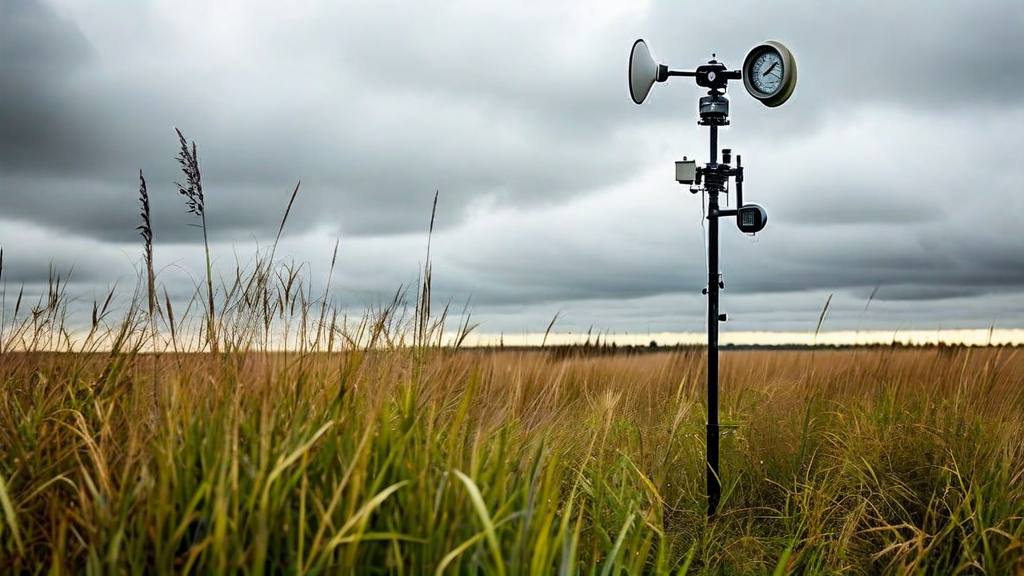
On-farm weather stations deployed at multiple locations capture this microclimate variability and enable management decisions calibrated to actual local conditions rather than regional averages. Modern wireless weather stations that measure temperature, humidity, wind speed, precipitation, solar radiation, and leaf wetness can be deployed for a few hundred dollars per location and feed data wirelessly to cloud platforms in real time. The value of this data becomes apparent quickly: a single prevented frost event through timely activation of wind machines or irrigation-based frost protection can recover the entire capital cost of a microclimate monitoring network in a single night.
Shifting Planting Windows and Crop Selection
Long-term climate trend data combined with detailed on-farm records is enabling farmers to make more informed decisions about crop selection and planting timing. In many regions, the last spring frost date has moved measurably earlier over the past thirty years, and the first fall frost date has moved later — extending the growing season in ways that open opportunities for different crop types or additional cropping cycles. At the same time, increased summer heat and more frequent drought periods are making some traditional crops riskier and demanding attention to drought-tolerant varieties and heat-resistant cultivars.
Data-driven crop selection starts with building a local historical record that goes beyond the standard period-of-record averages. Growing degree day accumulation patterns, soil temperature trends, precipitation distribution across the season, and the frequency of specific stress events — extended dry periods, high-temperature spikes above critical crop thresholds, excessive moisture at pollination — should be analyzed at the field or farm level to inform variety selection and rotation planning. Many advanced seed companies and extension services now provide decision support tools that match variety characteristics to local climate risk profiles, and these tools are most useful when fed with actual farm-level climate records rather than generic regional data.
Water Stress Management Through Early Detection
Drought stress is one of the most costly and increasingly frequent climate challenges facing farmers. The traditional indicator of water stress is visible wilting, but by the time a crop shows visual stress symptoms it has already experienced yield-reducing physiological impacts. The most advanced climate-resilient farms use data to detect early water stress before it becomes visible — and intervene before yield potential is irreversibly lost.
Continuous soil moisture monitoring provides the most direct early warning of developing water deficit. When soil moisture in the root zone drops below established thresholds for a given crop and growth stage, the data triggers alerts that prompt irrigation before visible stress occurs. In dryland farming situations where irrigation is not available, the same data informs application decisions for drought stress mitigation inputs — foliar nutrient applications, growth regulator applications that reduce canopy water loss, and management practices that improve soil water storage capacity. Canopy temperature sensors, which detect the temperature differential between stressed and unstressed plant canopies, provide a complementary early warning signal that is independent of soil measurement and captures water stress across the entire plant rather than at a single soil monitoring point.
Cover Crops and Soil Water Storage
Building soil organic matter through cover cropping is one of the highest-return climate adaptation strategies available to farmers, specifically because of organic matter's impact on soil water-holding capacity. Each one percent increase in soil organic matter enables the soil to hold approximately 20,000 additional gallons of water per acre — a reservoir that is available to crops during dry periods without the infrastructure cost of irrigation. On non-irrigated farms in semi-arid regions, the difference between 1.5 and 3.0 percent organic matter can be the difference between a profitable crop and a complete loss in a drought year.
Data-driven cover crop management goes beyond simply choosing a cover crop species and planting it. Effective programs use soil moisture and temperature data to optimize cover crop termination timing — balancing the water consumed by the cover crop against the organic matter and soil protection benefits it provides before termination. In drier years, earlier termination conserves more water for the cash crop; in wetter years, later termination maximizes biological contributions. Biomass prediction models that use accumulated growing degree days and weather data to estimate cover crop growth enable farmers to make this timing decision proactively, before soil moisture deficit becomes critical.
Heat Event Management and Crop Protection
Extreme heat events are becoming more frequent and intense across agricultural regions of the United States. For many crops, brief exposures to temperatures above critical physiological thresholds — 95°F for corn pollination, 86°F for tomato fruit set, 90°F for soybean pod fill — can cause permanent yield losses that no subsequent management can recover. The window for intervention during a heat event is narrow, and the decisions that need to be made — whether to irrigate, whether to apply evaporative cooling, whether to adjust harvest schedules — require real-time data and pre-developed response protocols.
Climate-resilient farms build heat event response systems that combine local weather forecast monitoring with automated alerts calibrated to specific crop growth stages. A system that knows the current growth stage of a corn crop can generate an alert when a forecast shows temperatures approaching pollination-critical thresholds — giving the farm operation time to position irrigation equipment for evaporative cooling before the stress occurs. This kind of proactive management requires both the technical infrastructure for data collection and forecasting and the organizational infrastructure of documented decision rules that tell staff exactly what actions to take when which alerts are triggered.
Building Long-Term Climate Records for Strategic Planning
The long-term value of farm-level climate monitoring programs is the archive of data they create. A farm that has been systematically recording daily weather, soil conditions, crop performance, and input applications for ten or fifteen years has an extraordinary resource for understanding how its particular landscape responds to climate variability. This historical record enables meaningful statistical analysis of which fields perform best in dry years, which crops are most sensitive to heat, and which management practices most consistently protect yield under stress.
Long-term farm data archives are also increasingly valuable for insurance and financing purposes. Climate-smart agriculture lending programs at major agricultural banks offer preferential rates to farms that can document sustainable and climate-resilient practices — and a well-maintained data record is the most credible documentation available. Government conservation programs including USDA EQIP and CSP provide substantial financial incentives for adoption of practices documented in the research literature as climate-beneficial, and farms with quantitative data on their practice adoption have a distinct advantage in program applications and payment calculations.
Key Takeaways
- On-farm microclimate monitoring reveals local variability that regional weather data misses and enables management decisions calibrated to actual field conditions.
- Historical climate trend analysis at the farm level informs more accurate crop selection and planting timing decisions than reliance on regional averages.
- Early detection of water stress through soil moisture and canopy temperature monitoring enables intervention before yield-reducing physiological damage occurs.
- Building soil organic matter through cover cropping is a high-return climate adaptation strategy that increases drought-year water storage without infrastructure investment.
- Heat event response systems combining forecast monitoring with pre-developed action protocols enable proactive protection of critical crop growth stages.
- Long-term farm data archives have compounding strategic and financial value for planning, insurance, and access to climate-smart lending and conservation programs.
Conclusion
Climate resilience is not a defensive posture — it is a competitive capability that separates thriving farms from struggling ones as weather volatility increases. The data infrastructure needed to build this capability — weather stations, soil sensors, analytical platforms, and institutional knowledge about how to respond to the insights they generate — is more accessible and more affordable than at any previous time. Farms that begin building this capability today are not just protecting themselves against this year's weather events; they are creating an asset that will guide better decisions for decades and position their operations for sustained success in an era of increasing climate uncertainty.